DIGITIMES Trains Its Lens on 800VDC: AI's Next Bottleneck Is Power
DIGITIMES examines why power, not silicon supply, is now the binding constraint on AI infrastructure — and why data centers are shifting toward 800-volt DC distribution to feed AI-class racks.
- By
- Rebecca Stone
- Filed
- Channel
- AI & Compute
- Read
- 3 min read
AI compute has outgrown the electrical architecture of the data center, and DIGITIMES has published an analysis examining the industry's shift toward 800VDC power distribution as the next infrastructure frontier.
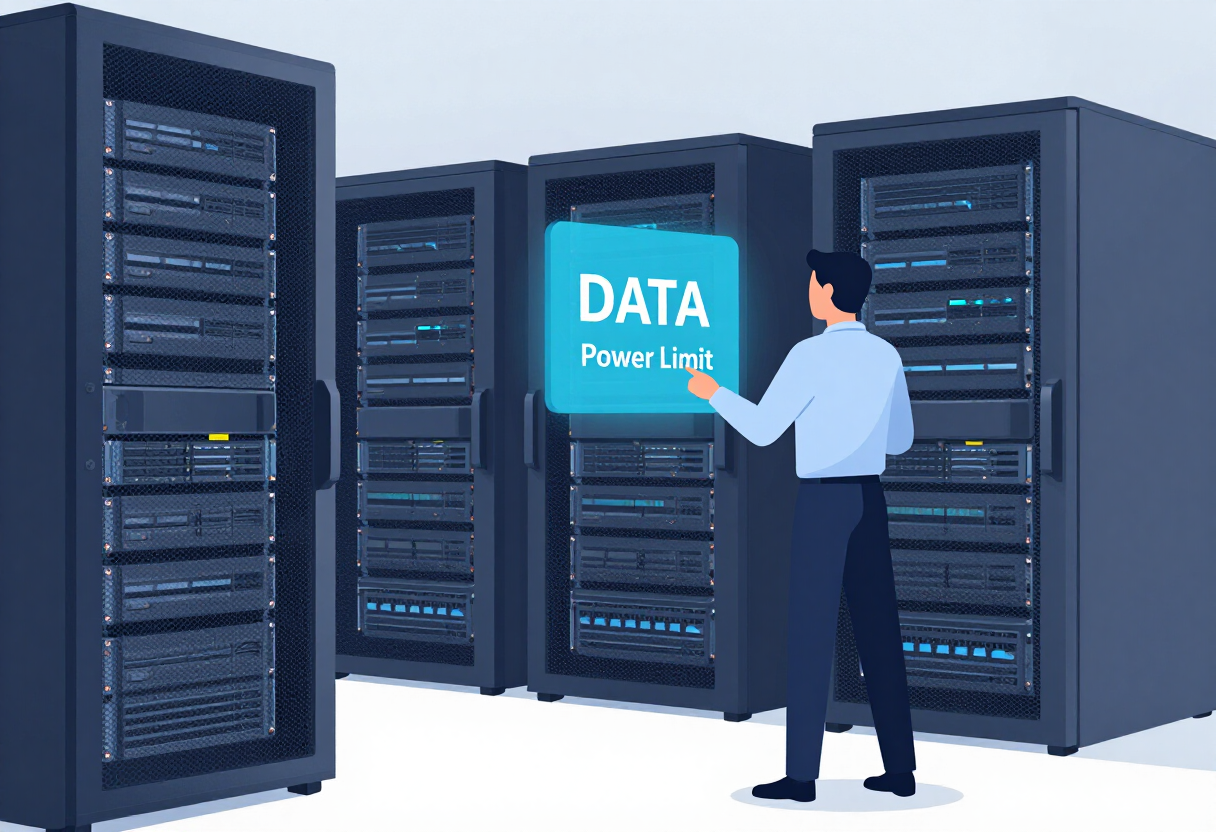
The report, distributed via PR Newswire, frames power — not silicon supply, cooling, or networking — as the binding constraint on AI infrastructure buildouts. As accelerator racks draw ever more current at conventional low-voltage DC levels, the copper, conversion stages, and thermal losses involved become the limiting factor in facility design.
The core of the analysis is a transition the industry has begun discussing openly: moving rack-level power distribution from the legacy 54V DC standard toward 800 volts of direct current. At higher voltage, the same wattage travels at lower current, which cuts resistive losses, reduces cable mass, and simplifies the conversion chain between the grid and the GPU.
Why does voltage matter for AI racks?
The physics is straightforward. Power equals current times voltage, so doubling voltage halves the current needed to deliver the same watts. Lower current means thinner conductors, less waste heat in distribution, and fewer lossy step-down conversions inside the rack.
For AI clusters, where individual racks now aggregate the demand of an entire legacy server room, that arithmetic stops being an engineering nicety and becomes an economic one. Copper and conversion hardware scale with current, and at AI-class densities the conventional approach strains both rack design and facility budgets.
DIGITIMES positions 800VDC as the industry's answer: a distribution scheme that treats the data center less like a building full of computers and more like a compact industrial power plant feeding high-density compute loads directly.
What changes across the supply chain?
The shift touches more than server power supplies. A move to 800VDC reworks the component stack from the wall to the die:
- Power semiconductors. High-voltage DC distribution leans heavily on silicon carbide and advanced MOSFET technologies capable of efficient conversion at these levels, pulling wide-bandgap suppliers into the AI supply chain.
- Rack and busbar design. Higher voltage allows lighter distribution hardware, reshaping what mechanical and interconnect vendors must deliver.
- Facility architecture. Data center operators face decisions about centralizing AC-to-DC conversion and rethinking uninterruptible power topologies.
- Energy sourcing. The report situates the voltage debate inside a broader reckoning with how AI facilities will obtain gigawatt-scale electricity at all.
Who is driving the conversation?
According to the DIGITIMES analysis, the 800VDC direction is emerging as a cross-industry conversation rather than a single vendor's initiative, with hyperscalers, chipmakers, and power-supply manufacturers all weighing in on standards and timelines.
That matters commercially. When the largest AI buyers converge on a new power standard, component makers who can supply qualified silicon, converters, and distribution gear early capture the redesign cycle — and those who bet on the wrong voltage regime risk missing an AI capex wave measured in the hundreds of billions of dollars industry-wide.
The analysis also draws a straight line between power architecture and AI scalability itself. If distribution cannot keep pace with accelerator roadmaps, the constraint moves from the fab to the facility, and compute deployment schedules slip regardless of chip supply.
What comes next?
DIGITIMES presents the 800VDC transition as an open question of timing and standards rather than a settled migration. Expect specifications, pilot deployments, and vendor roadmaps around high-voltage DC distribution to intensify as AI power densities climb — the report suggests the winners of the next phase of the AI buildout will be decided as much in electrical engineering as in process nodes.
Source: Google News: semiconductors
More from Rebecca Stone
Show full bio
Correspondent covering media and advertising at Chip Dispatch.
164 articles
Related articles
ubs-power-supply-will-just-cover-ai-chip-boom-if-everything-gets-built-01689683
UBS: Power Supply Will Just Cover AI Chip Boom — If Everything Gets Built
pue-blind-spot-why-ai-rack-power-demands-a-new-efficiency-metric-08764e5f
PUE Blind Spot: Why AI Rack Power Demands a New Efficiency Metric
data-center-cooling-the-ai-infrastructure-trade-nobody-is-watching-8a79833b
Data Center Cooling: The AI Infrastructure Trade Nobody Is Watching
power-not-accelerators-now-caps-data-center-ai-scaling-6bd78ff3
Power, Not Accelerators, Now Caps Data Center AI Scaling