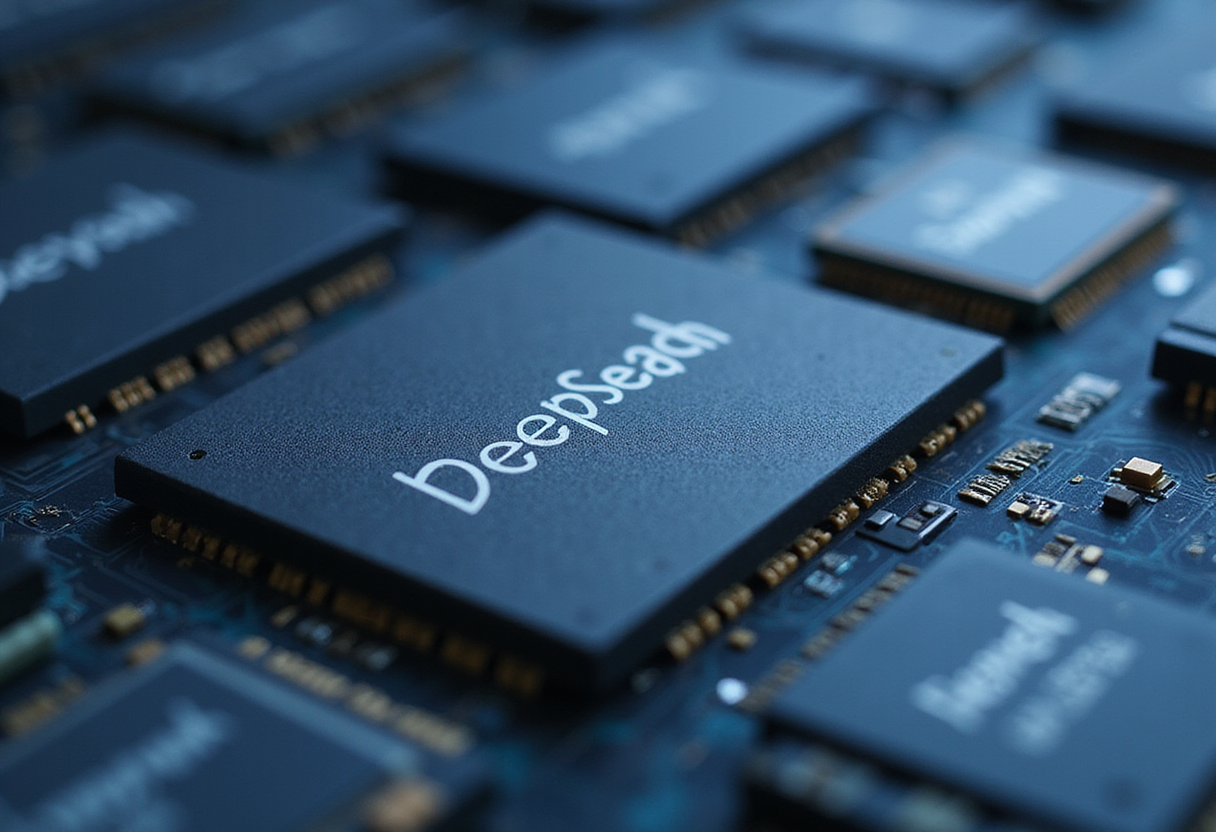
DeepSeek Partners With Huawei on Chip Programming Tools
DeepSeek is working with Huawei to build chip programming tools, Reuters reports, aiming to loosen Nvidia's software grip and anchor China's AI stack on domestic accelerators.
- By
- Rebecca Stone
- Filed
- Channel
- Semiconductors
- Read
- 2 min read
DeepSeek has partnered with Huawei to develop chip programming tools, a move the Chinese AI lab expects will reduce its reliance on Nvidia, Reuters reports.
The partnership targets one of the most consequential chokepoints in China's AI supply chain: the software layer. Nvidia's dominance in AI accelerators rests as much on its CUDA programming environment as on its silicon. Developers build and optimize models against CUDA toolchains, which creates switching costs that persist even where alternative hardware is available. For Chinese AI firms, that software dependency has become a strategic vulnerability as US export controls tighten around Nvidia's highest-end data center products.
By building programming tools with Huawei — whose Ascend accelerator line has emerged as China's most credible domestic alternative to Nvidia GPUs — DeepSeek is positioning itself to train and serve models on hardware that Washington cannot restrict. Reuters characterizes the collaboration as aimed specifically at reducing reliance on Nvidia, which suggests the tools under development would let developers write for Huawei silicon workflows that today assume CUDA compatibility.
The pairing carries weight on both sides. DeepSeek has become China's most closely watched AI lab, having demonstrated that frontier-adjacent model training can be done at costs far below those of its US rivals. Huawei, in turn, has poured resources into its Ascend ecosystem, including the CANN software stack, and has been working to convince domestic developers that its tooling can approach CUDA's maturity. A flagship AI customer collaborating directly on programming tools signals that the ecosystem gap — long cited as the main reason Chinese firms stayed on Nvidia hardware — is narrowing from the customer side rather than only from the vendor side.
For Nvidia, the development fits an emerging pattern in its most important growth market. Chinese AI companies continue to buy whatever Nvidia products remain legally exportable, but the largest players are hedging aggressively. Domestic accelerator demand has strengthened as firms seek supply certainty, and software investments like the DeepSeek–Huawei effort extend that hedge from procurement into the developer stack itself. Each tool built for domestic silicon makes future migration cheaper, even if near-term Nvidia shipments to China continue.
The deal also illustrates how China's AI buildout and its semiconductor localization push now reinforce each other. AI labs gain hardware partners with deep pockets and state backing; chipmakers gain demanding customers whose workloads stress-test their software in ways that accelerate maturation. Reuters does not disclose financial terms, timelines, or the specific tooling in scope, so the immediate commercial impact remains unquantified.
The direction, however, is clear. If DeepSeek and Huawei deliver programming tools that let leading Chinese models run efficiently on domestic accelerators, Nvidia's software moat in China — and with it a meaningful slice of its data center growth story — will face its most serious homegrown challenge to date.
Source: Google News: AI chips
More from Rebecca Stone
Related articles
deepseek-releases-huawei-ai-chip-tools-that-could-replace-nvidia-s-4ea88129
DeepSeek Releases Huawei AI Chip Tools That Could Replace Nvidia's
deepseek-builds-software-bridge-to-huawei-ai-chips-pressuring-nvidia-086badd4
DeepSeek Builds Software Bridge to Huawei AI Chips, Pressuring Nvidia
deepseek-and-huawei-team-up-on-ai-chip-software-198b1e84
DeepSeek and Huawei Team Up on AI Chip Software
deepseek-partners-with-huawei-on-chip-programming-tools-3c45ff25
DeepSeek Partners With Huawei on Chip Programming Tools