DeepSeek Taps Huawei in New AI Chip Push Against Nvidia in China
DeepSeek's new partnership with Huawei channels AI training and inference workloads toward domestic Ascend chips, accelerating the shift away from Nvidia inside China.
- By
- Grace Kim
- Filed
- Channel
- AI & Compute
- Read
- 3 min read
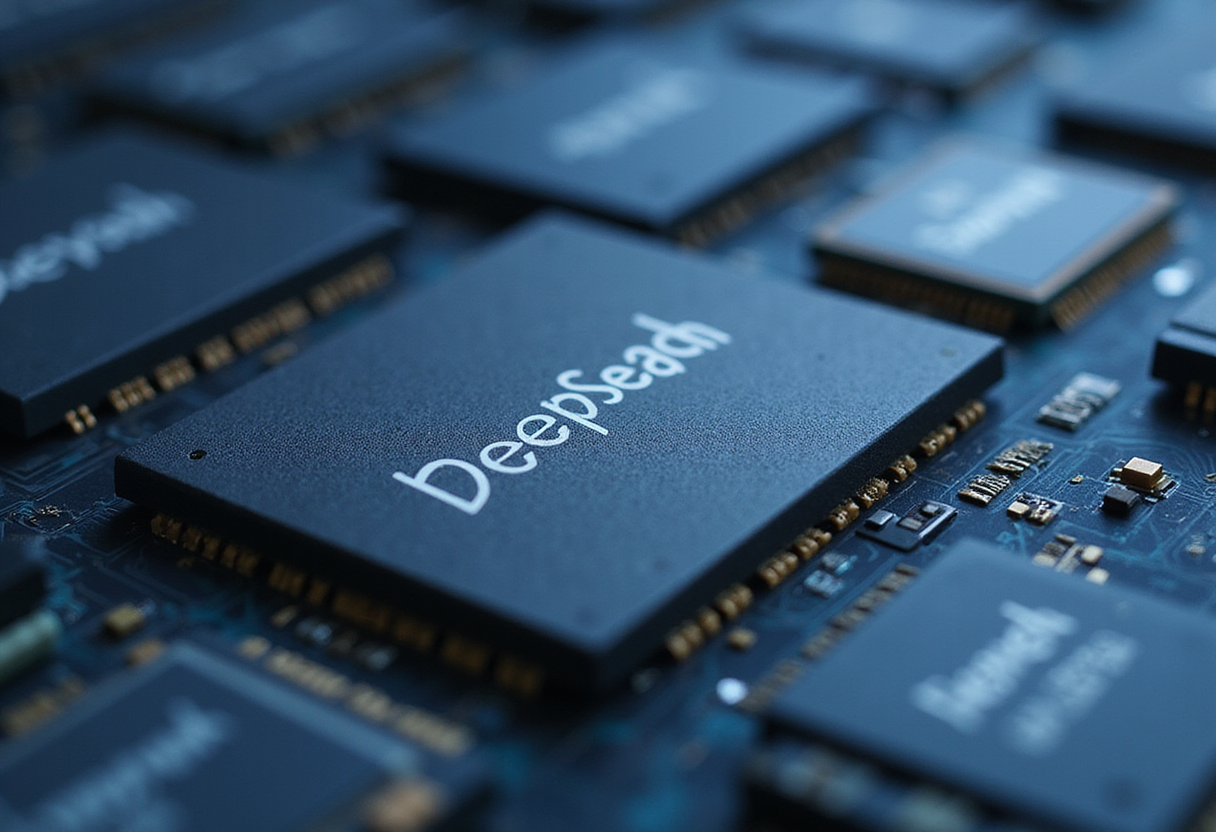
Chinese AI lab DeepSeek has signed a new chip partnership with Huawei, directing a portion of its AI training and inference workloads toward Huawei's domestic accelerators and tightening the competitive pressure on Nvidia inside the world's largest semiconductor market.
The arrangement, reported by WION, signals a deliberate shift in China's AI compute supply chain. DeepSeek, which gained global attention in early 2025 for releasing competitive open-weight reasoning models with modest training budgets, has until now leaned on a mix of Nvidia hardware and Chinese alternatives. Aligning more closely with Huawei's Ascend line commits DeepSeek to a vendor that can supply advanced AI chips at scale inside China without depending on US export-license approvals.
What does the partnership change?
For Nvidia, the deal deepens a trend that has been visible since 2023. US export controls have blocked the company's H100, H200, and Blackwell-class parts from Chinese hyperscalers and AI labs, leaving only the H20 — a cut-down Hopper derivative — as the most advanced part Nvidia can legally sell into the country. Each tightening of the US rules has pushed more Chinese AI buyers toward Huawei Ascend chips, Cambricon accelerators, and other domestic alternatives. A DeepSeek endorsement adds a high-profile reference customer to Huawei's AI chip roster.
For Huawei, the validation matters. The company's Ascend 910B and 910C have become the de facto domestic substitutes for restricted Nvidia silicon, and shipments have scaled rapidly across 2024 and 2025 to meet demand from Tencent, Alibaba, Baidu, and state-owned cloud operators. DeepSeek's reported alignment suggests Huawei's software stack — historically considered a weakness against CUDA — has reached a usability threshold where a frontier-model lab can build production systems on top of it.
How does this reshape China's AI chip race?
The competitive picture inside China now has a clearer three-tier structure. At the top, Huawei Ascend parts lead on raw training throughput, with Cambricon, Hygon, and Biren filling specialized slots. Nvidia's H20 holds a foothold in inference workloads where its mature CUDA software ecosystem still delivers a productivity edge. Below that, a long tail of startups targets edge AI and automotive designs.
DeepSeek's efficiency-focused model architecture makes it an unusually strong test case for Huawei's silicon. If the company can match or exceed its prior inference economics on Ascend hardware, the result becomes a public benchmark that other Chinese AI labs can point to when justifying their own Huawei procurement decisions. The benchmark effect — not just the direct purchase volume — is what makes the partnership commercially significant for Huawei.
What are the limits of the move?
Several constraints remain unaddressed. Huawei's accelerator production depends on SMIC's mature-process manufacturing, which has not yet demonstrated high-volume 5nm or 3nm output comparable to TSMC. HBM memory sourcing also routes through Korean suppliers operating under US allocation pressure. Scaling DeepSeek-class training runs to tens of thousands of accelerators will test both the foundry pipeline and the memory supply chain in ways that smaller inference deployments have not.
Software remains the deeper variable. CUDA's library depth, compiler maturity, and developer mindshare took Nvidia more than a decade to build. Huawei's CANN software stack, paired with the open-source MindSpore and the newer open-source alternatives gaining traction in China, has narrowed the gap but not closed it. DeepSeek's own published training recipes, if ported to Ascend, will serve as a stress test for that software layer.
What comes next?
DeepSeek's roadmap through 2025 and 2026 is likely to become a public test of whether a frontier Chinese AI lab can scale on fully domestic silicon from training through deployment. Success would accelerate the substitution cycle across the rest of China's AI industry and force Nvidia to defend a shrinking share of the Chinese accelerator market with the H20 and whatever follow-on compliance parts Washington permits. Failure would leave Nvidia's residual China business intact but cap Huawei's expansion at inference and mid-scale training workloads, keeping the competitive boundary drawn at advanced training where HBM and leading-edge process access still favor foreign suppliers.
Source: Google News: AI chips
More from Grace Kim
Show full bio
Market editor covering industry trends and analytics at Chip Dispatch.
264 articles
Related articles
deepseek-releases-huawei-ai-chip-tools-that-could-replace-nvidia-s-4ea88129
DeepSeek Releases Huawei AI Chip Tools That Could Replace Nvidia's
deepseek-and-huawei-team-up-on-ai-chip-software-198b1e84
DeepSeek and Huawei Team Up on AI Chip Software
deepseek-partners-with-huawei-to-build-on-ascend-cut-nvidia-reliance-6223055a
DeepSeek Partners With Huawei to Build on Ascend, Cut Nvidia Reliance
deepseek-teams-with-huawei-to-build-ai-software-stack-for-ascend-3ece0885
DeepSeek Teams With Huawei to Build AI Software Stack for Ascend