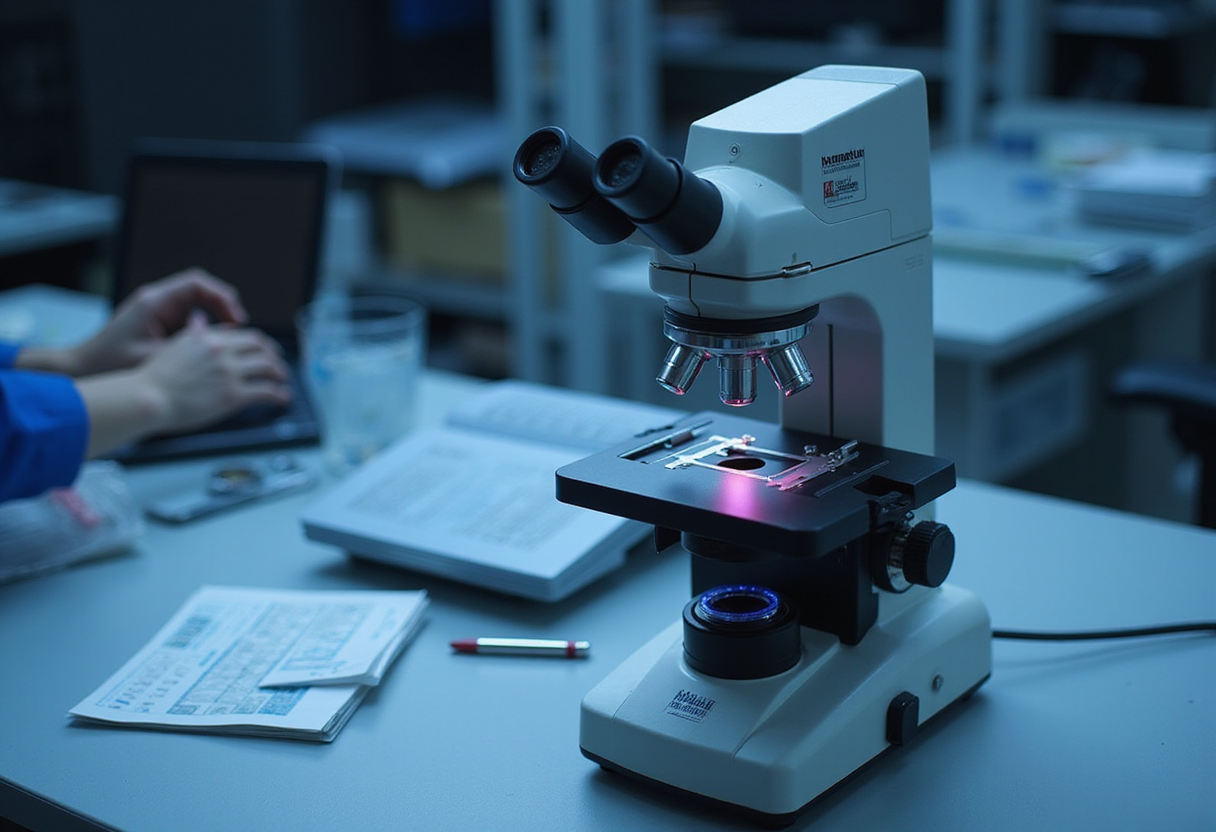
Hamamatsu Packs Seven Failure-Analysis Modes Into iPHEMOS-DDX Microscope
Hamamatsu Photonics will debut the iPHEMOS-DDX inverted emission microscope at ISTFA 2026 in San Antonio, October 4-8. The platform folds seven failure-analysis techniques into one chassis for AI chiplet and HBM package debug.
- By
- Sophie Lindqvist
- Filed
- Channel
- Chip Manufacturing
- Read
- 3 min read
Hamamatsu Photonics will debut the iPHEMOS-DDX, a single-platform inverted emission microscope that consolidates seven failure-analysis techniques, at ISTFA 2026 in San Antonio, Texas, from October 4 through October 8. The system merges PEM, Thermal/LIT, LSM, OBIRCH, DALS, EOP/EOFM and TD Imaging into one chassis.
What does the platform actually combine?
Each of the seven modes addresses a different defect signature inside an advanced package:
- PEM (photoemission) for hotspot photon localization
- Thermal/LIT (laser-induced thermal) for resistive fault isolation
- LSM (laser scattering microscopy) for particle and void detection
- OBIRCH (optical beam induced resistance change) for current-path analysis
- DALS (dynamic analog laser stimulation) for logic-state fault mapping
- EOP/EOFM (electro-optical probing and frequency mapping) for high-speed signal inspection
- TD Imaging for time-domain defect imaging
Analysts at ISTFA tracks have repeatedly identified OBIRCH and DALS as the workhorse techniques for stacked-die and chiplet debug, where conventional front-side probing cannot reach buried metal layers.
Why does AI packaging need a unified tool?
Generative AI accelerators and High Bandwidth Memory stacks layer multiple dice and through-silicon vias in one package, stretching failure-analysis cycles from hours to days. According to Hamamatsu, the iPHEMOS-DDX responds directly to that trend by collapsing technique swaps into one instrument. Operators no longer need to transfer wafers between dedicated benches for thermal, optical or electrical scans.
The microscope accepts direct docking from three directions onto existing probers and testers. That interface flexibility shortens integration time inside labs already running ATE platforms from the major testers, and it prevents contamination events that arise when samples move between tools.
How does Hamamatsu's recent M&A shape the company?
Hamamatsu acquired NKT Photonics in 2024 and renamed the unit Hamamatsu Photonics A/S in June 2026 to serve as its laser and fiber business. Combined with the company's historical strength in photodetectors and electron tubes, the iPHEMOS-DDX pairs the new laser's excitation paths with the parent's imaging electronics. The vertical integration positions Hamamatsu against incumbents such as Sony's formerly-acquired Thermo Fisher Scientific-style optical tools and specialty competitors like Onto Innovation and Camtek, which sell separate platforms for each modality.
What is the public-sector angle?
In 2025, Japan's NEDO awarded roughly 3 billion yen over three years to Hamamatsu, AIST and RIKEN for ultra-fast camera and spatial light modulator work tied to neutral-atom quantum computers. The funded camera and SLM roadmap shares core sensor and laser IP with the iPHEMOS-DDX line, giving Hamamatsu a cross-market amortization runway that pure-play failure-analysis vendors lack.
Where does ISTFA 2026 fit in the product cycle?
ISTFA is the dominant North American forum for failure analysis, drawing chipmakers, OSATs and equipment vendors each fall. A San Antonio debut places the tool in front of U.S. customer engineering teams evaluating AI accelerator debug capacity for the 2027 production ramp of HBM4 stacks and CoWoS-L interposers. Hamamatsu did not disclose pricing, ship dates or a public beta roster in its announcement.
If the iPHEMOS-DDX holds cycle-time gains demonstrated at ISTFA demonstrations, OSATs could redirect capital budgets now split across three or four single-mode benches toward a single vendor by the end of 2027.
Original: quantumzeitgeist.com
More from Sophie Lindqvist
Related articles
hamamatsu-launches-iphemos-ddx-inverted-emission-microscope-da9a29c6
Hamamatsu Launches iPHEMOS-DDX Inverted Emission Microscope
chip-inspection-equipment-makers-see-valuations-climb-e163096e
Chip Inspection Equipment Makers See Valuations Climb
intel-malaysia-expands-advanced-packaging-as-ai-chips-grow-more-complex-137993ca
Intel Malaysia expands advanced packaging as AI chips grow more complex
jedec-issues-jesd264-first-industry-wide-silicon-photonics-reliability-standard-712dc4d8
JEDEC Issues JESD264, First Industry-Wide Silicon Photonics Reliability Standard