Hardware & Components · 4 min read
Vertiv Extends 800 VDC Line With 1.5 MW Pod and 5 MW Data-Hall Units
Vertiv adds a 1.5 MW pod-level power center and a 5 MW solid-state transformer to its 800 VDC line, targeting AI racks beyond 300 kW ahead of Nvidia's Kyber rollout.
Key takeaways
- PowerDirect 9000 converts 480 VAC to 800 VDC at 1.5 MW per pod, scaling in 60 kW steps
- PowerNexus MV SST is a 5 MW solid-state transformer at up to 98% efficiency, supporting a 4.8 MW super pod
- Vertiv targets second-half 2026 for its 800 VDC line, ahead of Nvidia's Kyber and Rubin Ultra
- Rack shelves deliver 54 VDC to compute trays at up to 98.5% peak efficiency
- No prices, shipment dates or named customers were disclosed; pilots are underway
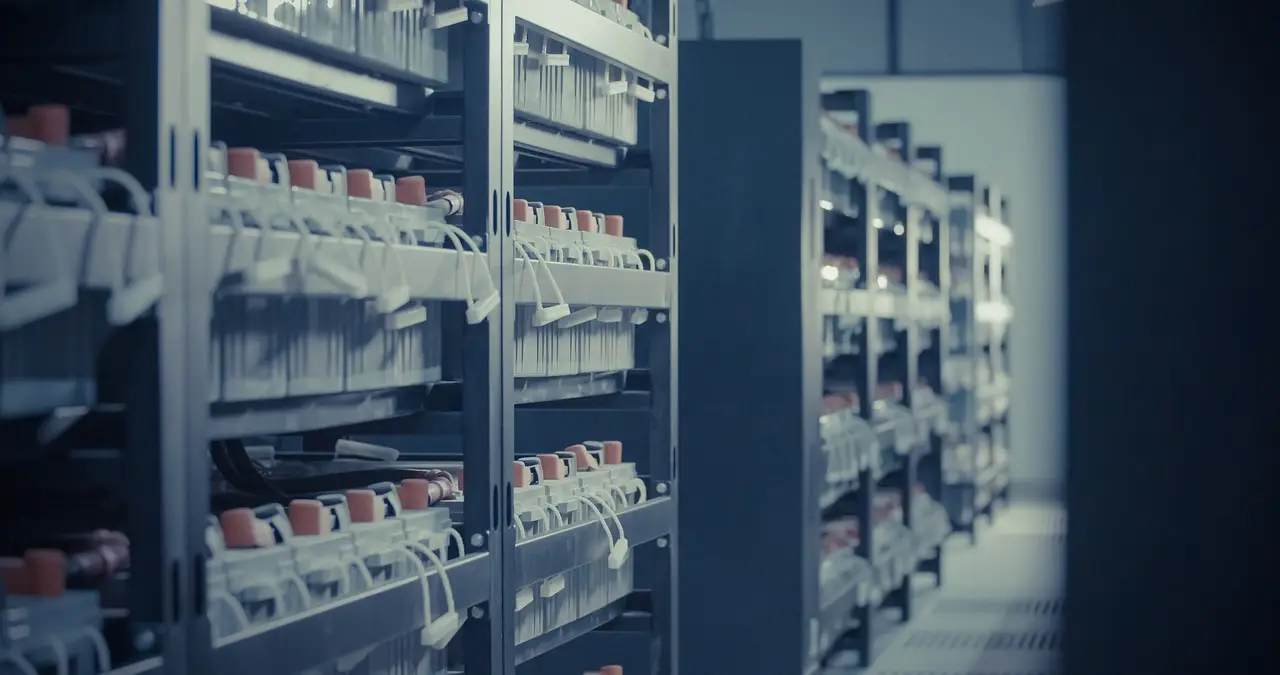
Vertiv (VRT) has added two 800-volt DC power systems rated at 1.5 MW and 5 MW, extending a product line that began with the PowerDirect 5000 power rack in May 2026. The company announced the units on Nov. 16 and displayed them at the SC26 supercomputing conference.
The PowerDirect 9000 power center converts 480 VAC to 800 VDC for a whole row or pod at 1.5 MW, scaling in 60 kW steps. The PowerNexus MV SST, a 5 MW solid-state transformer, converts medium-voltage AC to 800 VDC in a single stage at up to 98% efficiency, according to Vertiv.
Why 800 VDC, and why now?
The move follows Nvidia's push for higher-voltage power in AI racks. In May 2025, Vertiv said rack power needs in AI environments "scale beyond 300 kilowatts" and scheduled its 800 VDC portfolio for the second half of 2026, ahead of Nvidia's Kyber and Rubin Ultra platform rollouts. Higher voltage cuts the current, copper and heat losses needed to deliver the same power.
That physical trade is the whole mechanism of this product family. At 300 kW and above, conventional low-voltage distribution requires more copper and sheds more energy as heat, so raising the DC bus to 800 volts lowers losses at every link between the utility feed and the compute tray.
How the power train is built
Vertiv now covers four levels of the power train:
- PowerDirect 5000 — rack level, up to 800 kW
- PowerDirect 9000 — pod or row level, 1.5 MW
- PowerNexus MV SST — data hall level, 5 MW
- PowerDirect 3000 shelf — in rack, 90 kW
- EnergyCore Li5 battery — DC bus, 200 kW
The PowerDirect 9000 feeds power through Vertiv's PowerBar Track DC busway to 90 kW PowerDirect 3000 shelves in each rack. Those shelves convert 800 VDC down to 54 VDC for compute trays at up to 98.5% peak efficiency. The power center scales in 60 kW increments through 27 hot-pluggable power supply units, and EnergyCore Li5 battery cabinets connect to the DC bus at 200 kW each, with up to six in parallel.
Vertiv pitches the pod-level unit at colocation providers running mixed AC and DC loads and different GPU generations. The framing matters commercially: operators that refresh GPU fleets faster than power infrastructure need capacity they can grow in 60 kW steps rather than replacing in full blocks.
The PowerNexus MV SST is an outdoor, liquid-cooled, containerized unit. It removes two to three conversion steps from a conventional power train by converting medium-voltage AC to 800 VDC in one stage, and Vertiv says one unit can support a 4.8 MW "super pod" reference design without chaining.
A competitive field taking shape
Tesla unveiled its own solid-state transformer, Powercore, for batteries, solar and data centers the week before Vertiv's announcement. Solid-state conversion at medium voltage is turning into a contested category rather than a single vendor's roadmap.
Vertiv's release takes a measured view of adoption. It says the shift "will not follow a single architecture or timeline" and that AC and DC architectures are expected to coexist. "The 800 VDC power train is not just a new power product or conversion methodology; it is a set of architectures and system designs," said Scott Armul, Vertiv's chief product and technology officer.
What is confirmed, and what is not
The company gave no prices, no shipment dates and no named customers. What it did confirm is that pilot programs, technical validation and joint development work with customers are underway.
The efficiency figures of 98% for the MV SST and 98.5% for the rack shelves are Vertiv's own claims. The 4.8 MW super-pod figure is a reference design, not a deployed site.
Separately, Vertiv raised its annual dividend 60% to 40 cents a share earlier this month, a signal the company expects sustained cash flow from data center capital spending.
With 800 VDC volume still targeted for the second half of 2026 and Nvidia's Kyber and Rubin Ultra racks arriving around the same window, the next competitive test will be whether Vertiv's pilots convert into named deployments before rival solid-state transformer suppliers reach the same buyers.
mlq.ai (Source)
More from Tom Whitfield
Show full bio
Staff writer covering companies, deals and strategy in Semiconductors, chip manufacturing, hardware, AI compute at Chip Dispatch.
1,308 articles