Applied Materials Lifts EPIC R&D Center to $5 Billion as AI Fuels Spend
Applied Materials lifts its Sunnyvale EPIC center to $5 billion as top-ten chipmakers pour $67 billion a year into R&D on the back of AI-driven revenue.
- By
- Tom Whitfield
- Filed
- Channel
- Chip Manufacturing
- Read
- 4 min read
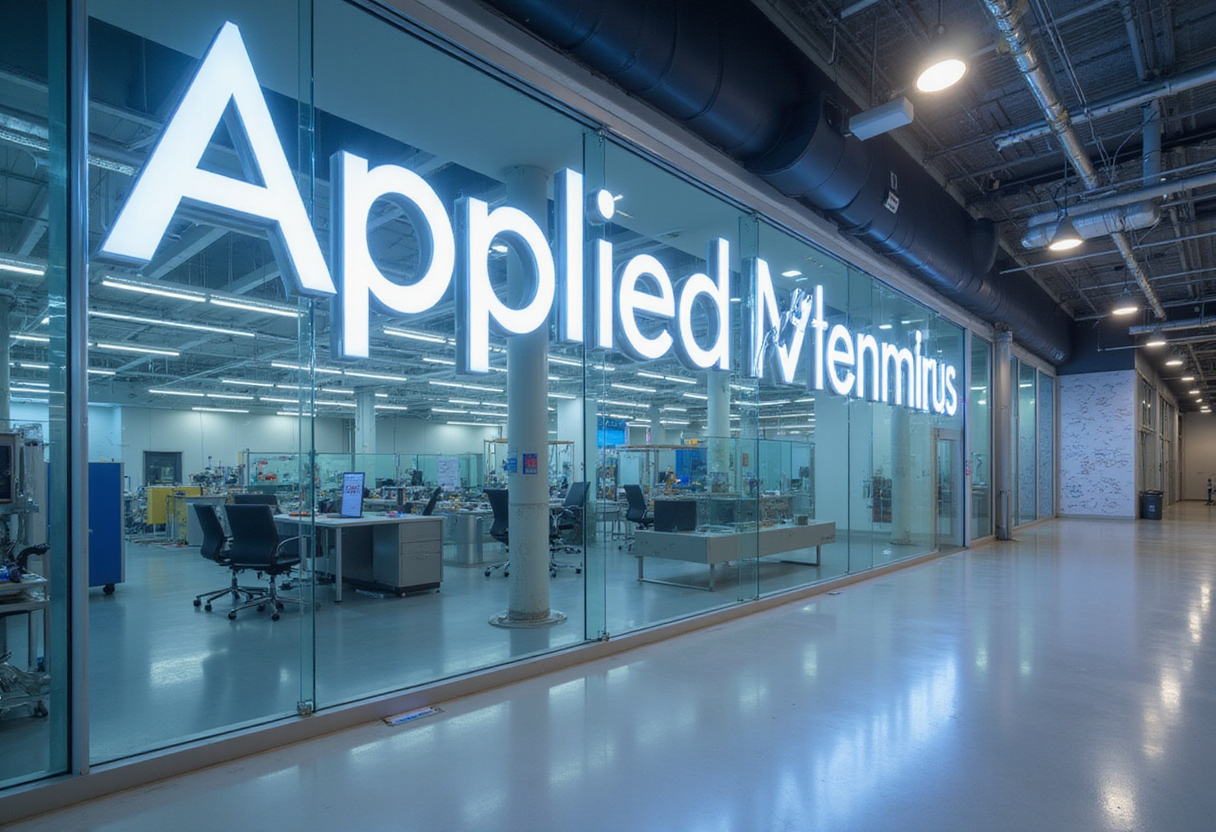
Applied Materials has raised the price tag of its Sunnyvale research campus to about $5 billion, up from the $4 billion it announced in 2023, as private money floods U.S. semiconductor R&D. The company unveiled the Equipment and Process Innovation and Commercialization (EPIC) Center in Sunnyvale, California, on 12 October.
The EPIC opening caps a season of large research commitments. In August, Micron disclosed a $10 billion, ten-year investment at its Boise, Idaho memory research lab, and SK hynix said it will spend $4 billion on an advanced packaging facility in West Lafayette, Indiana. Neither company specified how much of those funds would go to R&D.
Why is the money arriving now?
Washington has encouraged investment through the 2022 CHIPS and Science Act, tariffs on foreign components, and direct support for struggling domestic players such as Intel. But analysts and executives point to a simpler driver: AI demand.
"The best explanation is probably not about policy or politics and probably more about a big jump in revenue growth driven by AI demand," said Chris Miller of Tufts University, author of Chip War.
Tristan Holtam, chief strategy officer at Applied Materials, put numbers behind that view:
- The top ten semiconductor companies' revenue has grown roughly 150 percent since 2021, driven by AI demand.
- Those companies have raised R&D spending by 67 percent over the same period.
- They will collectively invest $67 billion in R&D this year.
That private figure dwarfs federal research money. The CHIPS Act allocated $11 billion for R&D spread over several years.
How is AI changing the research itself?
AI is not only funding the research; it is doing part of the work. Entegris, a materials science company based in Billerica, Massachusetts, uses AI tools to suggest candidate materials once engineers define performance targets for next-generation products.
"If you're an AI engineer, a chemist, a materials scientist, you can combine scientific understanding with AI-driven modeling and simulation to work backward from a target performance requirement," said Olivier Blachier, Entegris' chief innovation officer. The company also pilots AI screening of new materials, mirroring how drugmakers pre-screen molecules before synthesis.
At Applied Materials, Holtam said the company applies AI to material discovery, generative equipment design, and software development. "The timing is perfect for EPIC," he declared.
What does co-location actually fix?
The EPIC model attacks a specific bottleneck: shipping prototype equipment to customer pilot lines. "The traditional way of working to get brand new technology into the hands of our customers, the chip makers, was to ship a prototype piece of equipment from our lab into their pilot line. That's a kind of heart-in-your-mouth type of situation," Holtam said.
"That was always a huge point of contention," he added, over how mature a prototype had to be before leaving the building. Applied Materials analyzed 15 years of internal R&D, ran pilot programs of its customer-in-the-lab approach, and got what Holtam called "very, very encouraging results."
TSMC, Samsung, Micron, Broadcom and others have now agreed to set up their own facilities inside EPIC, separated by digital firewalls and physical barriers. "We're eliminating handoffs," Holtam said. The stated goal is to cut several years from the typical 10-to-15-year path from early discovery to commercialization.
Physical proximity is drawing others too. The Japanese packaging company Resonac opened its first U.S. R&D facility in April. "These companies have a very strong reason to want to be close to their customers and close to their customers' customers so they can make the right investments for the next five to ten years," Miller said.
Who gets left out?
The CHIPS Act's own big-tent R&D facilities are behind schedule or indefinitely paused, and EPIC's partners so far are industry leaders rather than startups. "Small and medium companies have to cooperate with bigger companies to feed into the giants," Blachier noted.
Closer university ties offer one partial answer, since universities already hold long-running federal research partnerships. Blachier also pointed to imec in Belgium as proof that pre-competitive research facilities, backed by patient national strategies in Europe and Asia, can anchor an entire ecosystem — something the U.S. still lacks at scale.
With private R&D spending now running at several times the federal contribution, the pace of U.S. chip innovation will likely be set in Sunnyvale-style campuses rather than in Washington.
Original: appliedmaterials.com
More from Tom Whitfield
Show full bio
Staff writer covering companies, deals and strategy in Semiconductors, chip manufacturing, hardware, AI compute at Chip Dispatch.
450 articles
Related articles
applied-materials-commits-5-billion-to-silicon-valley-r-d-hub-322e5cec
Applied Materials Commits $5 Billion to Silicon Valley R&D Hub
applied-materials-puts-5-billion-into-silicon-valley-r-d-1545cc06
Applied Materials Puts $5 Billion Into Silicon Valley R&D
applied-materials-puts-5-billion-into-silicon-valley-r-d-centre-aae52578
Applied Materials Puts $5 Billion Into Silicon Valley R&D Centre
applied-materials-commits-5-billion-to-silicon-valley-ai-chip-research-hub-0d3e3c8a
Applied Materials Commits $5 Billion to Silicon Valley AI Chip Research Hub